


The calculator above shows where a USDT perpetual position is liquidated, how large to open it from your risk and stop, and what it makes in money and ROE. It uses each exchange's own formula and its own maintenance-margin table, because the same trade does not liquidate at the same price everywhere.
How to use it
- Pick the exchange and the symbol. Binance, OKX, Bitget, MEXC, KuCoin and Hyperliquid, with the 44 most traded coins and their official logos.
- Set direction, margin mode and leverage. In cross mode, add your wallet balance: it becomes the margin behind the position.
- Enter the entry price and the size, as a position value in USDT or as a quantity of the coin.
- Read the liquidation price with its distance from the entry, the tier the exchange applies and the loss when it is reached.
Position size works out the quantity that loses exactly your risk at your stop, fees included, and warns when the liquidation price would come before the stop. Profit & ROE gives the result between an entry and an exit, with fees and funding.
How the liquidation price is calculated
A position is liquidated when its margin, after the loss, falls to the maintenance margin the exchange requires. The exchanges agree on that, and differ on where they measure the maintenance margin:
Binance, OKX, Bitget, KuCoin, HyperliquidLP = (M + D − s·q·E) ÷ (q·(MMR + f) − s·q)
MEXCLP = E − s·(M − (q·E·MMR − D)) ÷ q
M is the margin behind the position, q the quantity, E the entry price, s is +1 for a long and −1 for a short, MMR the maintenance-margin rate of the size's tier, D the deduction the exchange applies at that tier, and f a fee some exchanges keep in reserve (OKX 0.05%, Bitget 0.06%, KuCoin 0.06%).
That figure is the one Binance's own calculator shows for the same position. So are 71,115.53 for a 20x short of 2 BTC with 6,800 USDT of margin, and 87,649.40 for a 10x short of 0.5 BTC in cross mode with a 10,000 USDT wallet.
The same trade on six exchanges
A 10x isolated long of 0.5 BTC at 68,000, with the tier tables of 13 November 2026:
| Exchange | Liquidation price | Maintenance rate | How it was checked |
|---|---|---|---|
| Hyperliquid | 61,974.68 | 1.25% | Its published formula |
| Bitget | 61,482.82 | 0.40% + 0.06% fee | Its published formula |
| KuCoin | 61,482.82 | 0.40% + 0.06% fee | Its help-centre example |
| OKX | 61,476.64 | 0.40% + 0.05% fee | Its help-centre example |
| Binance | 61,445.78 | 0.40% | Binance's own calculator |
| MEXC | 61,268.00 | 0.10% | Its help-centre example |
Seven hundred dollars between the closest and the furthest. On a tight stop that is the difference between being stopped out and being liquidated.
Leverage and the distance to liquidation
| Leverage | Long liquidated at | Short liquidated at |
|---|---|---|
| 3x | −33.07% | +32.80% |
| 5x | −19.68% | +19.52% |
| 10x | −9.64% | +9.56% |
| 20x | −4.62% | +4.58% |
| 50x | −1.61% | +1.59% |
| 100x | −0.60% | +0.60% |
BTCUSDT on Binance, first tier, isolated. Roughly one divided by the leverage, minus the maintenance rate: at 100x an ordinary 0.6% wick is enough.
Isolated or cross margin
| Isolated | Cross | |
|---|---|---|
| Margin behind the position | Only what you assign | The whole wallet |
| Liquidation price | Closer | Further away |
| What a liquidation can take | That position's margin | The balance |
Cross mode buys distance with the whole account. Isolated mode with a sensible size and a stop is how most traders keep a single bad trade from becoming a bad month.
Why the liquidation price moves
- Funding is paid from or into the margin every funding period.
- Adding margin pushes it away; adding to the position changes the average entry and the size.
- In cross mode every change of the wallet, including other positions' profit and loss, moves it.
- A larger size can fall into a higher tier with a higher maintenance rate.
How to avoid being liquidated
Put the stop first and size from it. With a 10,000 USDT account, 1% risk, an entry at 68,000 and a stop at 67,320, the calculator gives 0.13375 BTC: the stop loses 100 USDT including 0.05% fees each way, and at 10x the position needs 909.50 USDT of margin. The liquidation price, 61,445.78, sits far beyond the stop.
Open the same size at 125x and the liquidation price becomes 67,726.90, before the stop. The calculator says so and names the largest leverage that keeps the stop first: 71x. Leverage does not change what the stop costs; it only decides whether the stop is reached at all.
Profit, ROE, fees and funding
A long of 0.5 BTC from 68,000 to 70,000 makes 1,000 USDT on the price. Fees of 0.05% on the way in and out cost 34.50, so the net is 965.50. On 3,400 USDT of margin at 10x that is a 28.40% ROE. Funding is added when you give the rate and the number of payments: a long pays a positive rate, a short receives it.
Every futures trade, journaled from the exchange
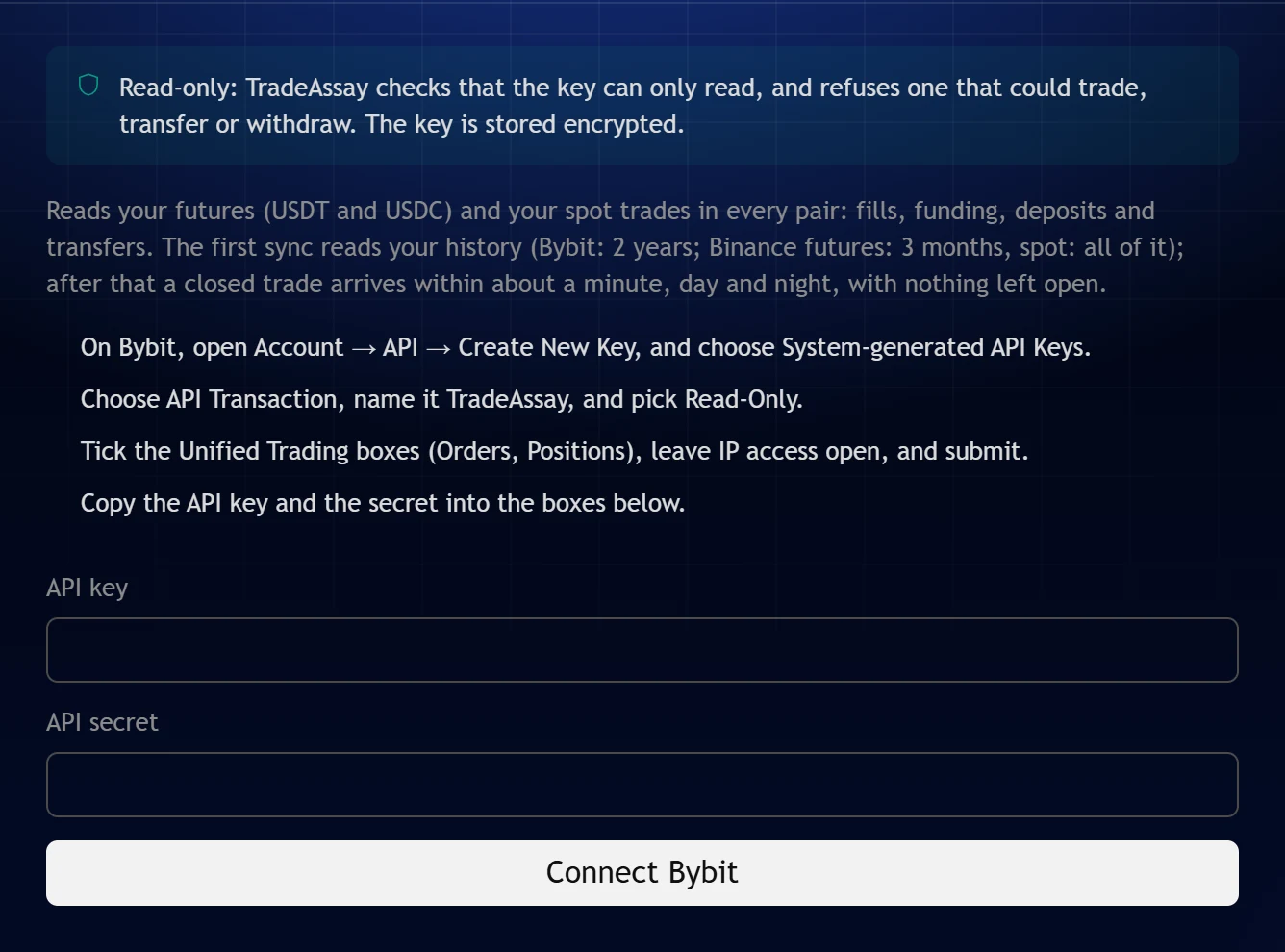
The calculator plans one trade. TradeAssay keeps all of them: it reads your Binance, Bybit and Hyperliquid futures with a read-only key, with fees and funding, so you see what each trade really risked and made, in R.
Frequently asked questions
How is the liquidation price calculated?
The position is liquidated when its margin, after the loss, falls to the maintenance margin the exchange requires. Binance, OKX, Bitget, KuCoin and Hyperliquid measure that maintenance margin at the liquidation price itself; MEXC measures it at the entry price. The calculator uses each exchange's own formula and its own tier table.
Why is my liquidation price different on another exchange?
Because the maintenance margin rates and the formulas differ. A 10x long of 0.5 BTC at 68,000 liquidates at 61,445.78 on Binance, 61,476.64 on OKX, 61,268.00 on MEXC and 61,974.68 on Hyperliquid (tables of 13 November 2026).
Is isolated or cross margin safer?
Isolated margin limits the loss to the margin of that position. Cross margin uses the whole balance, which pushes the liquidation price further away but puts all of it at risk.
Does leverage change how much I lose at my stop?
No. The loss at the stop depends on the size and the distance to the stop. Leverage changes the margin the position ties up and how close the liquidation price is.
Why does my liquidation price move while the position is open?
Funding payments and fees change the margin, adding margin or adding to the position changes the numbers, and in cross mode every change of the wallet balance moves it.
Is the calculator free?
Yes. It needs no sign-up and runs in your browser.

Built by the TradeAssay Team, traders with more than seven years of experience in forex, gold, indices and futures. The exchanges' tier tables are read from their own public data; the formulas were checked against Binance's calculator and the worked examples in OKX's, KuCoin's and MEXC's help centres.
TradeAssay journals your futures trades from the exchange and shows what each one really risked and made.
Start freeTrading crypto futures with leverage carries a high level of risk and is not suitable for every investor. This calculator and this page are arithmetic and illustration, not investment advice. Exchanges change their tiers, fees and rules; check the figure your exchange shows before you trade.