EnglishفارسیTürkçe

Features

Journal Backtest Strategy Tester Automatic Backtest Auto Test Prop Firm Scripts Replay & Trade Charts Analysis Playbook Mentor Broker sync

Resources

Pricing Learn Forex calculator Crypto futures calculator Symbols Supported brokers Sign in Get started
ProductPlaybook

Rules you can put a price on.

Write each setup as a checklist, tick it while you trade, and your results split in two: what you made when you followed it, and what you lost when you didn't. It is the most persuasive number in trading, and it is yours.

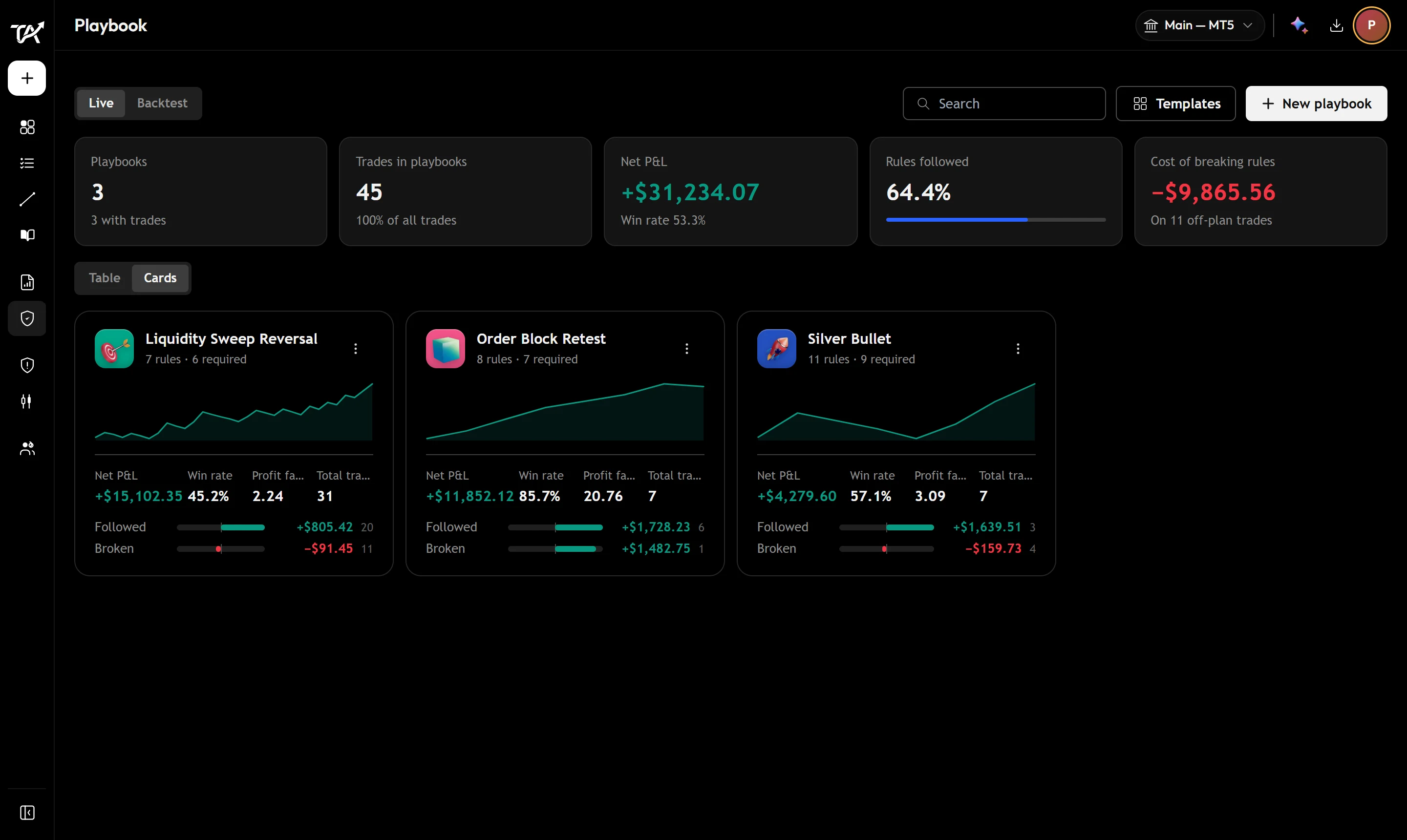
The Playbook tab: three playbooks of a real journal, 64.4% of their rules followed and −$9,865.56 lost to breaking them; each playbook with its equity, net P&L, win rate and profit factor, followed against broken

In a minute

To the dollar
What breaking your own rules has cost, worked out from your trades, followed against broken.
Rule by rule
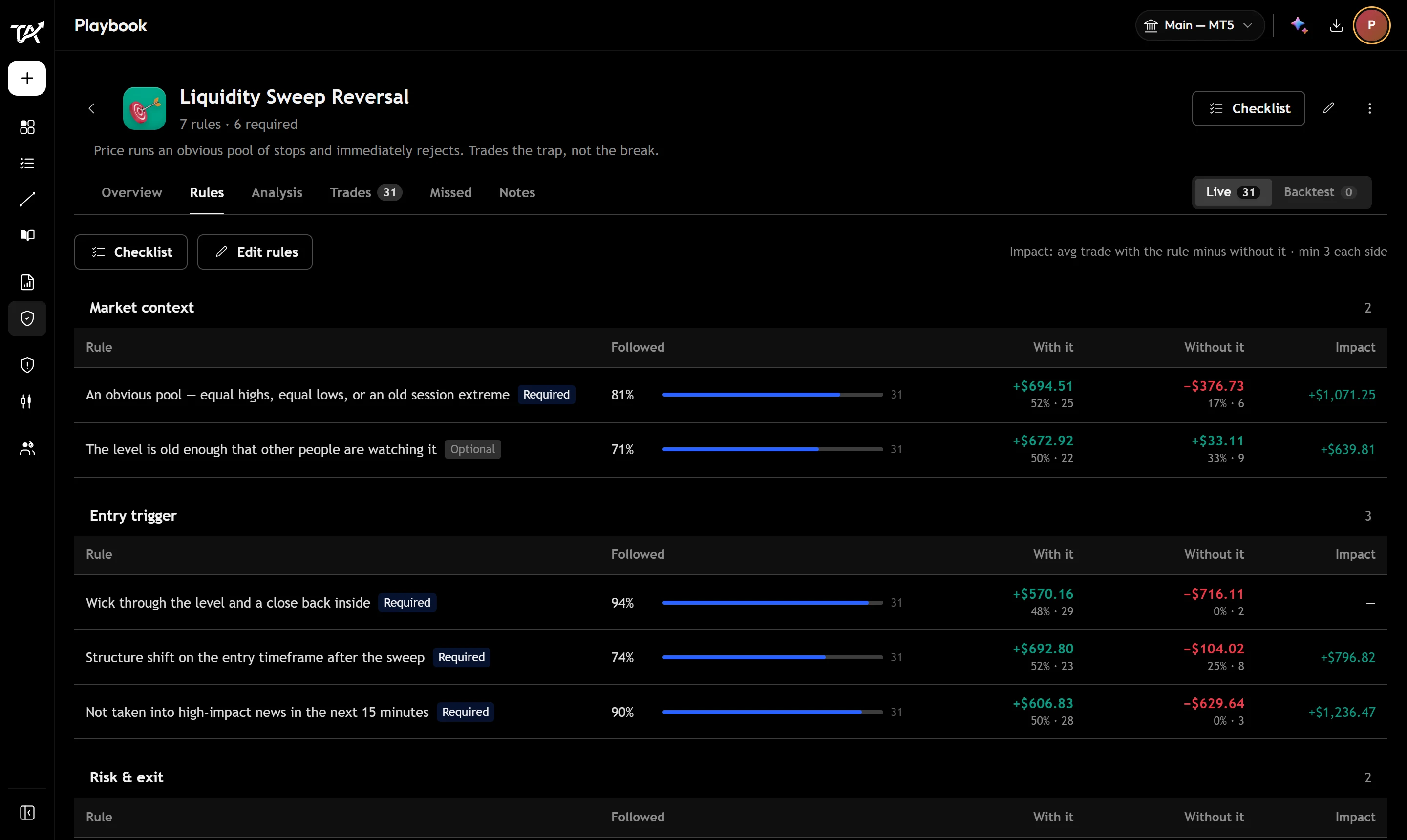
Each rule's impact: the average trade with it, against without it.
10 templates
From the Silver Bullet to funded-account discipline, to rewrite in your own words.
Ticked at entry
The checklist sits in the trade form, answered before the outcome is known.
Live and backtest
Tested results and traded results for the same rules, side by side, never mixed.
Free
Playbooks and rule tracking are on every plan.

How it works

  1. Write the setupFrom a template or blank: its rules in groups, which are required, its sessions and its daily cap.
  2. Tick it as you tradePick the playbook in the trade form and tick the rules you kept — or open its checklist before the trade.
  3. Watch it splitEvery trade becomes followed, broken or not checked, and the playbook's results split with it.
  4. Keep what worksEach rule's impact shows which ones carry the setup and which you can stop checking.
Followed against broken

The cost of breaking your own rules, to the dollar.

“Stick to the plan” is advice. A figure on the screen — what the off-plan trades cost you this quarter — is a reason. Every playbook shows both sides: the trades that followed it and the ones that didn't.

  • Net P&L, win rate, profit factor and expectancy for each playbook.
  • The share of rules you actually tick, trade by trade.
  • An equity curve that marks each trade as followed, broken or not checked.
  • The cost is shown once both sides have at least 5 trades, so a couple of trades can't shout.
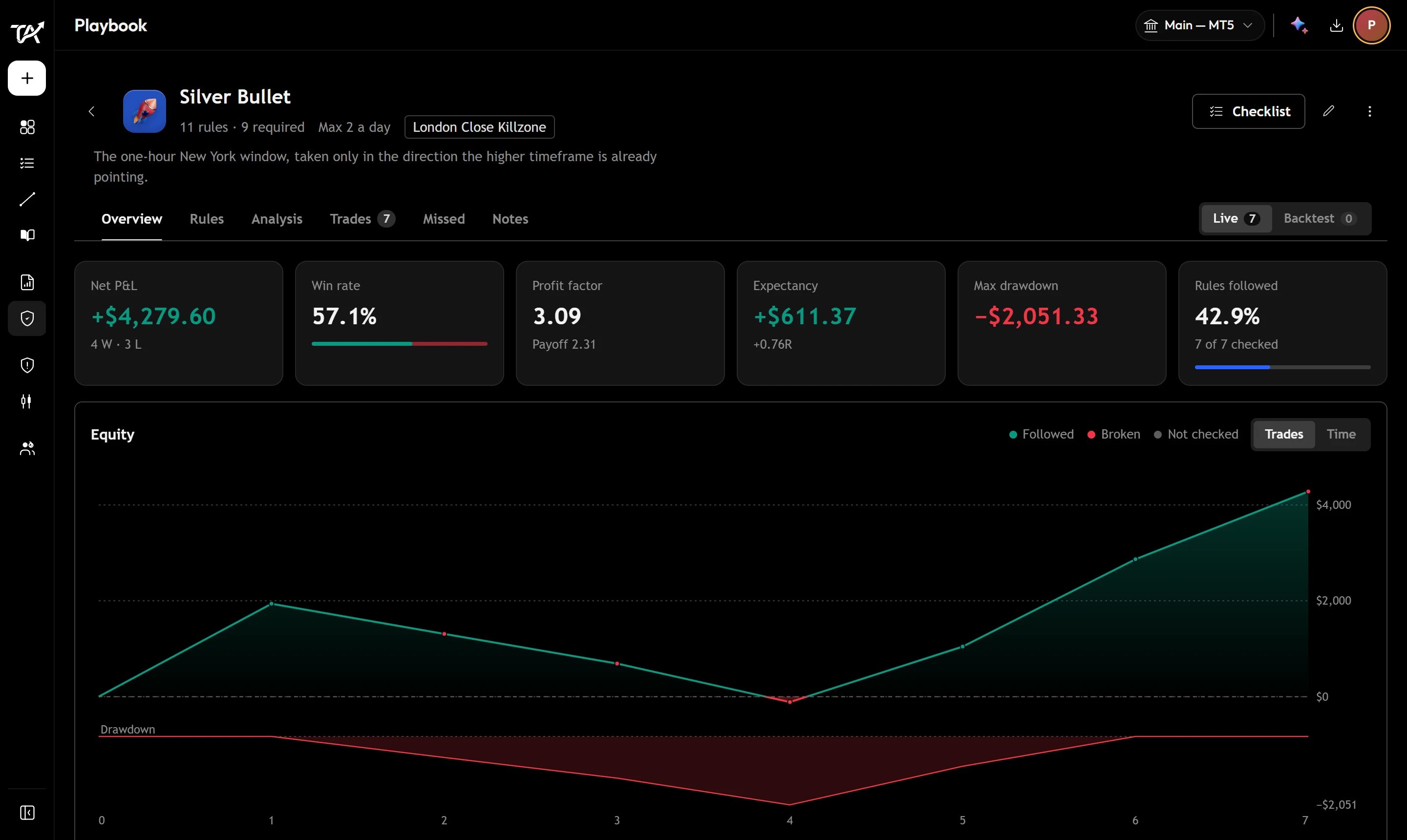
The Silver Bullet playbook's own page: 11 rules, 9 of them required, at most 2 trades a day in the London Close killzone; its net P&L, win rate, profit factor, expectancy, drawdown and rules followed, and its equity with each trade marked followed or broken
Rule by rule

Find the one rule that carries the setup.

Each rule gets its own line: the average trade when it was met, against when it wasn't. Some rules turn out to be the whole edge. Others are superstition, and you can stop checking them.

  • Impact shown only when both sides have enough trades to mean something.
  • Required and optional rules, grouped the way you think about the setup.
  • How often each rule is followed, with its share of the trades.
A playbook's rules, each with how often it was followed and the average trade with it and without it — an obvious pool of liquidity followed 81% of the time, worth +$1,071.25 a trade
Analysis

When the setup works, and when it doesn't.

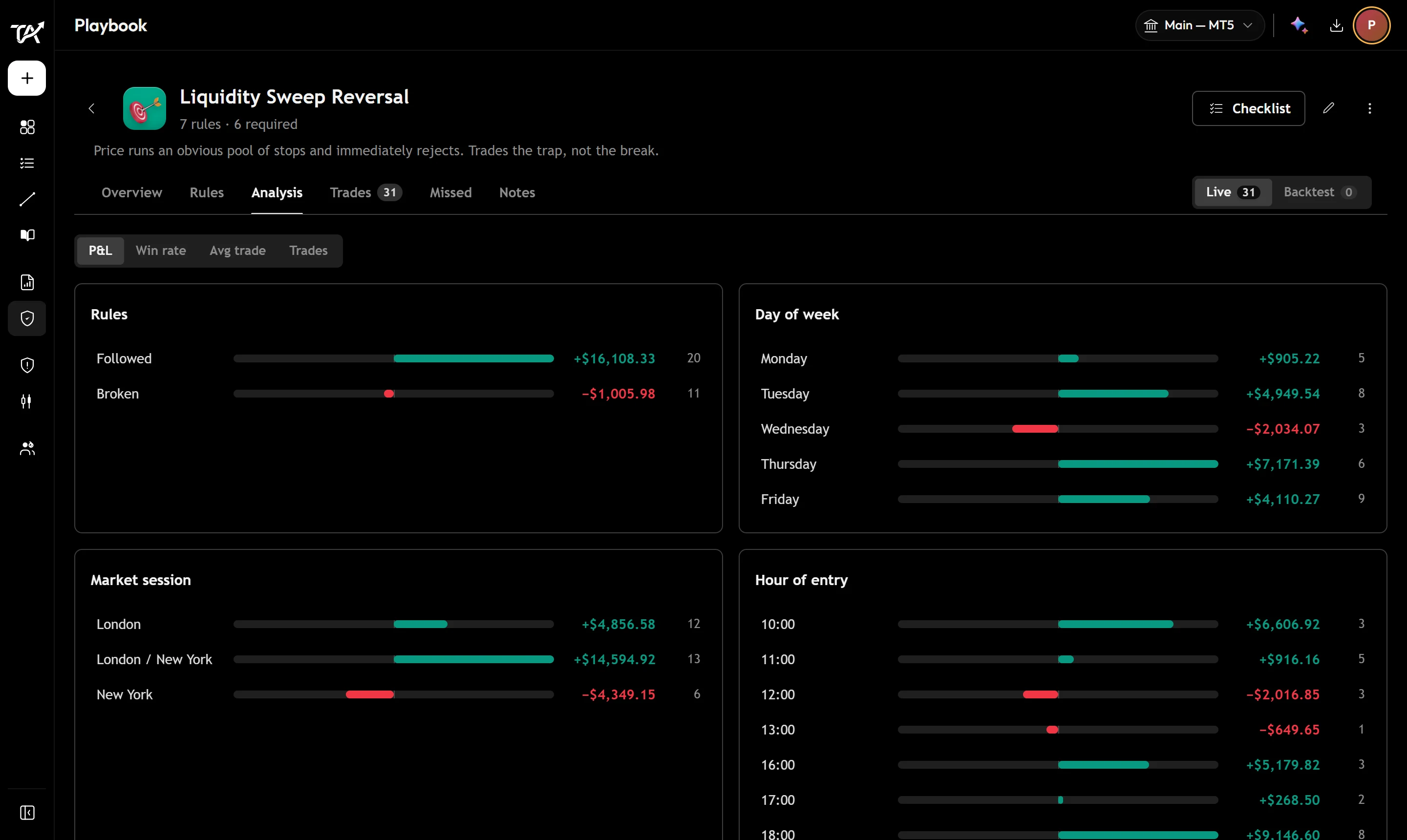
Each playbook has its own analysis: its result by rules followed, by day of the week, by market session and by hour of entry — in money, win rate, average trade or count.

  • Its trades, its missed trades and your own notes on the setup, each on a tab of its own.
  • Log the setups you saw and didn't take — the hesitation has a price too.
A playbook's analysis: its P&L with the rules followed and broken, by day of the week, by market session and by hour of entry
Templates

Start from a setup traders already use.

Ten templates written as checklists: Silver Bullet, Order Block Retest, Liquidity Sweep Reversal, Opening Range Breakout, Fresh Zone, Trend Pullback, Stretched Fade, Session Momentum Scalp, Swing Continuation and Funded Account Discipline. Nothing is saved until you make it yours.

  • Limits too: the most trades a day, and the sessions the setup is allowed in.
  • A mark for each playbook from a set of 49 3D icons, on its own colour.
  • A trade outside the allowed sessions, or over the daily cap, is flagged on its own.
Live and backtest

Test the rules before you trust them.

Yes. Tag backtest trades with the playbook and its page shows the tested and the live results side by side.

  • Tested results and traded results for the same rules, never mixed.
  • The checklist sits in the trade form, so it's answered while you still don't know the outcome.

Specifications

A playbookName, description, mark and colour; rules in groups, each required or optional; allowed sessions; most trades a day; largest size
Its pageOverview, Rules, Analysis, Trades, Missed, Notes; live or backtest
FiguresNet P&L, win rate, profit factor, expectancy, drawdown, rules followed, cost of breaking rules, each rule's impact
Templates10, written as checklists
Where it's tickedThe trade form, the trade's panel, the pre-trade checklist, the backtester's journal

What each plan includes

Playbooks and rule tracking need no subscription.

FeatureFreeProElite
Playbooks with checklistsIncludedIncludedIncluded
Journal: entry, import, calendar, day pagesIncludedIncludedIncluded
Backtest sessionsNo backtesting (7-day trial: unlimited)Unlimited backtest sessionsUnlimited backtest sessions
Overview and core analysisIncludedIncludedIncluded

Compare every plan

What it does not do

  • It can't tick the rules for you. Whether a rule was kept is your call; trades you don't check stay out of the comparison.
  • It doesn't trade the setup. A playbook is a checklist and a scorecard, not an automated strategy.
Questions

About playbooks.

Do I have to tick the checklist on every trade?

No. Trades you don't check are shown as not checked, and they stay out of the followed-against-broken comparison instead of skewing it.

Can I use a playbook in backtests?

Yes. Tag backtest trades with the playbook and its page shows the tested and the live results side by side.

What if my setup isn't in the templates?

Start blank: name it, write the rules you actually check, mark which are required, and set its limits.

How is the cost of breaking rules worked out?

The average followed trade minus the average broken one, times the number of broken trades — shown once both sides have at least 5 trades.

Your next trade deserves a reason.

Bring in your history and see what it says — free, in a few minutes.

Create your free account
Help centre

Answers to what traders ask us most — and a ticket to a person when they aren't enough.

Open help
Write to us

support@tradeassay.com — read by the people who build the app.

Send an email
Learn

Long reads on sample size, R and prop-firm rules, each with a calculator.

Start reading