


The calculator above works out how many lots to trade so that a stop loss costs exactly what you decided to risk. It also gives the pip value, the profit or loss between two prices, and the margin a position needs, for forex, gold, indices, crypto and futures.
How to use the calculator
- Choose the symbol and your account currency. Search the list or type your broker's own name: EURUSDm, XAUUSD.pro and US30.cash are all recognised.
- Enter your balance and your risk. The risk is what you accept to lose if the stop is hit, as a percentage of the balance or as money.
- Enter the stop loss. Type its distance in pips, or switch to Price and give the entry and the stop. A target is optional and adds the profit and the risk to reward.
- Read the size. It is rounded down to the lot step, so the trade never risks more than you asked for.
The other three tabs use the same symbol and account: Pip value for what one pip is worth at a size, Profit for the result between an entry and an exit, and Margin for what the position ties up at your leverage.
The position size formula
Lots = Money at risk ÷ (Stop in pips × Pip value of one lot)
Take a $10,000 account, 1% risk and a 50-pip stop on EURUSD.
If the division gives 0.3184, the size is 0.31, not 0.32. Rounding up would put more money at risk than the figure you chose, and over a hundred trades those small excesses add up.
Pip value of the main pairs
A pip is 0.0001 on most pairs and 0.01 on pairs quoted in yen. One standard lot is 100,000 units, so a pip is worth 10 units of the quote currency. When the quote currency is the dollar that is $10; otherwise it is converted at the pair's rate.
| Pair | One pip | 1.00 lot | 0.10 lot | 0.01 lot |
|---|---|---|---|---|
| EURUSD, GBPUSD, AUDUSD, NZDUSD | 0.0001 | $10.00 | $1.00 | $0.10 |
| USDJPY, EURJPY, GBPJPY | 0.01 | $6.26 | $0.63 | $0.06 |
| USDCHF | 0.0001 | $12.00 | $1.20 | $0.12 |
| USDCAD | 0.0001 | $7.02 | $0.70 | $0.07 |
| EURGBP | 0.0001 | $13.26 | $1.33 | $0.13 |
| XAUUSD (gold) | 0.10 | $10.00 | $1.00 | $0.10 |
Dollar account, at the reference rates of 12 November 2026 (USD/JPY 159.70, USD/CHF 0.8331, USD/CAD 1.4249, GBP/USD 1.3256). The Pip value tab gives today's figure for any pair and any size.
Standard, mini and micro lots
| Lot | Size typed | Units | One pip on EURUSD |
|---|---|---|---|
| Standard | 1.00 | 100,000 | $10.00 |
| Mini | 0.10 | 10,000 | $1.00 |
| Micro | 0.01 | 1,000 | $0.10 |
Most brokers accept sizes in steps of 0.01. On a cent account the balance is counted in cents and one lot is a hundredth of a standard lot: choose USC as the account currency and the calculator counts it that way.
Gold, indices, crypto and futures
Outside forex the size comes from the same division, but the stop is a distance in price and one lot is a different contract.
| Symbol | One lot or contract | A 1.00 move in price |
|---|---|---|
| XAUUSD (gold) | 100 ounces | $100 |
| XAGUSD (silver) | 5,000 ounces | $5,000 |
| US30, NAS100, US500 | 1 index | $1 |
| USOIL, UKOIL | 1,000 barrels | $1,000 |
| BTCUSD, ETHUSD | 1 coin | $1 |
| NQ · MNQ | 1 contract | $20 · $2 |
| ES · MES | 1 contract | $50 · $5 |
| GC · MGC | 1 contract | $100 · $10 |
Gold. A $5,000 account risking 2% has $100 to lose. With a stop $4.00 away, one lot loses 4 × $100 = $400, so the size is 100 ÷ 400 = 0.25 lots.
Futures. Contracts come whole. With $100 at risk and a 20-point stop on NQ, one contract would lose $400, so the answer is zero E-minis and the calculator shows the micro instead: 2 MNQ, risking $80.
Index, oil and crypto contracts differ between brokers. In MetaTrader, right-click the symbol, open Specification and type its contract size under Contract and costs.
When your account is not in dollars
Profit and loss are earned in the quote currency of the symbol and then converted into the currency of your account. A euro account trading EURUSD with €100 at risk and a 50-pip stop gets 0.22 lots, because a pip of one lot is $10, which is €9.02 at 1.1081.
On pairs where the dollar comes first, such as USDJPY, the pip value depends on the price itself. Give the stop as a price and the conversion uses that exact level: buying at 159.70 with a stop at 159.20 and $100 at risk gives 0.31 lots.
Conversions use the European Central Bank's daily reference rates. The rate is printed under the result, and Edit replaces it with your broker's price.
How much to risk per trade
Most traders who last keep each trade between 0.5% and 2% of the account. The reason is the losing streak that every method produces sooner or later.
| Risk per trade | After 5 losses in a row | After 10 losses in a row |
|---|---|---|
| 1% | −4.9% | −9.6% |
| 2% | −9.6% | −18.3% |
| 5% | −22.6% | −40.1% |
| 10% | −41.0% | −65.1% |
A method that wins half its trades has about an 80% chance of losing six in a row somewhere in 200 trades. In a prop firm challenge the limit is tighter still, and the size should be set against the loss limit, not the profit target: see why traders fail prop firm challenges.
Profit, loss and risk to reward
Profit = (Exit − Entry) × Contract size × Lots, converted to the account currency
Buy 0.20 lots of EURUSD at 1.1050 and close at 1.1125: 75 pips at $2.00 a pip is $150.00. With a commission of $7 per lot the net is $148.60. For a sell the difference is taken the other way.
Risk to reward compares the distance to the stop with the distance to the target. A 50-pip stop and a 100-pip target is 1 : 2, which pays for itself at any win rate above one in three, before costs.
Margin and leverage
Margin = Lots × Contract size × Price ÷ Leverage
0.20 lots of EURUSD at 1.1081 is a position worth $22,162. At 1:100 it ties up $221.62 of margin; at 1:30, $738.73. Leverage changes how much margin a position needs, not how much it loses: the loss at the stop is the same $100 at any leverage. What high leverage does is let you open a size far larger than your risk allows.
Five sizing mistakes
- The same lot on every trade. A 20-pip stop and an 80-pip stop at the same size are two very different risks.
- Rounding up. 0.318 is 0.31.
- Treating every pip as $10. On USDJPY it is nearer $6 at today's prices, on EURGBP $13.
- Assuming the contract. One lot of US30 is $1 a point at one broker and $10 at another.
- Forgetting costs. Commission and spread are part of the loss when the stop is hit. Type the commission under Contract and costs and the size allows for it.
Did you risk what you planned?
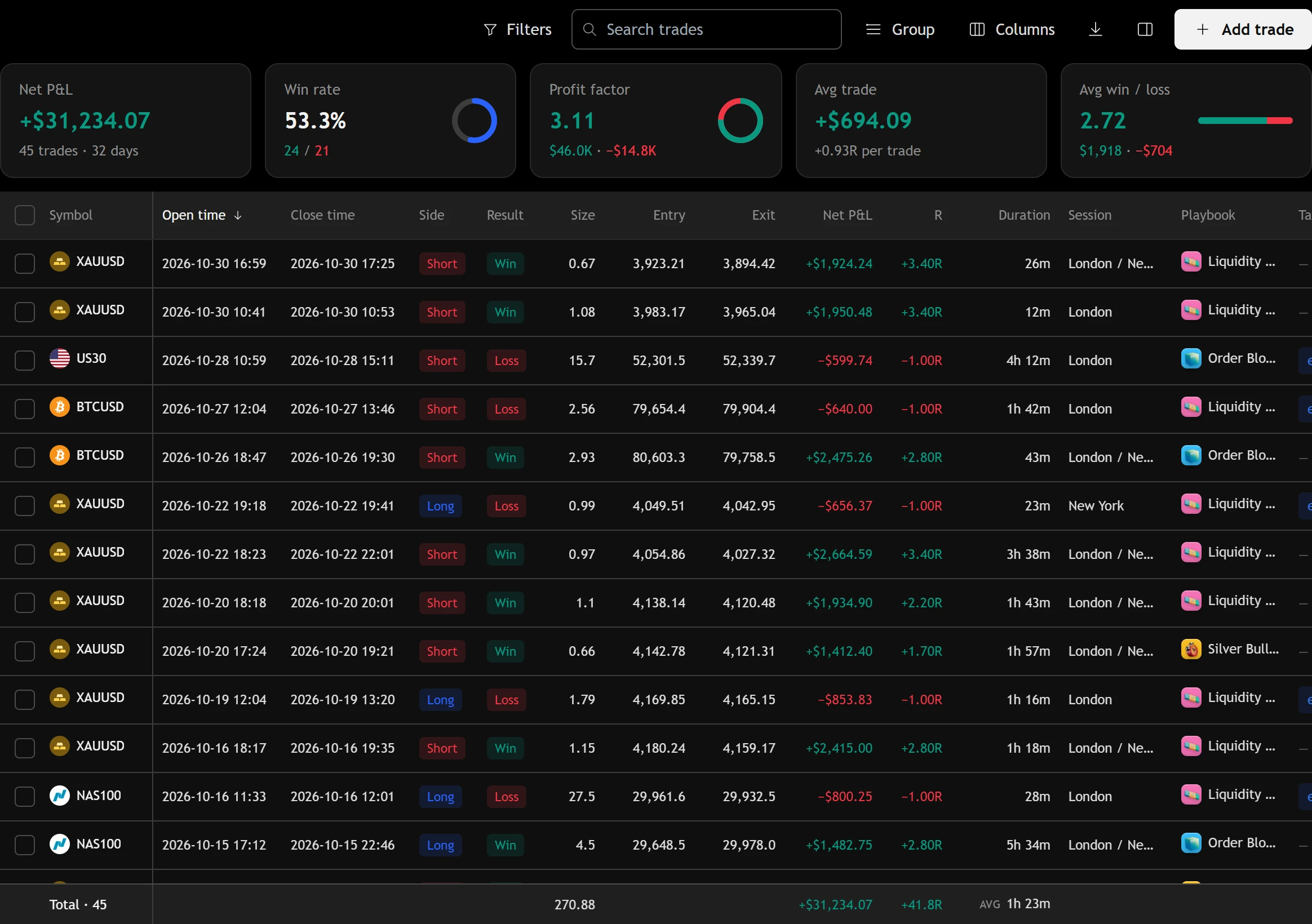
The calculator says what a trade should risk. Whether you kept to it is another question: stops get moved, sizes creep up after a win, and one oversized trade can undo a month. TradeAssay keeps that record. It takes in your trades from MetaTrader, cTrader and the large crypto exchanges, shows what each one really risked and made in R, and lets you replay a strategy on historical data with every order sized from your risk.
Frequently asked questions
What lot size should I use for a $100, $1,000 or $10,000 account?
At 1% risk and a 50-pip stop on EURUSD, a $10,000 account trades 0.20 lots and a $1,000 account 0.02 lots. A $100 account would need 0.002 lots, below the 0.01 minimum: 0.01 lot with that stop risks $5, which is 5% of the account. Use a tighter stop, a cent account or a larger balance.
How much is 0.01 lot in dollars?
0.01 lot is 1,000 units of the base currency. On EURUSD and other pairs quoted in dollars, one pip is worth $0.10. On gold (XAUUSD), 0.01 lot is one ounce, so a $1 move in price is $1.
How much is one pip of gold?
One lot of gold is 100 ounces. A $1.00 move is $100 per lot, a $0.10 move (what most platforms call a pip) is $10, and a $0.01 move is $1. On 0.01 lot those are $1, $0.10 and $0.01.
Is the forex calculator free?
Yes. There is no sign-up. It runs in your browser, and what you type stays on your device.
Where do the exchange rates come from?
From the European Central Bank's daily reference rates. The rate used is shown under the result, and you can replace it with your broker's price.
Why does my broker show a different number?
Usually the contract size, which differs between brokers on indices, oil and crypto, or the spread, commission and the exchange rate at the moment the trade closes. Open the symbol's specification in your platform and type its contract size under Contract and costs.
Can I use it for a prop firm challenge?
Yes. Enter the challenge balance and size each trade from the risk you allow yourself, which should come from the daily loss limit rather than the profit target. TradeAssay's prop firm tracker then watches the rules on your real trades.

Built by the TradeAssay Team, traders with more than seven years of experience in forex, gold, indices and futures. The calculator uses the same contract rules as the TradeAssay app, and every example on this page was worked out by it.
TradeAssay journals your trades and shows what each one really risked and made, in R.
Start freeTrading foreign exchange, futures and other leveraged products carries a high level of risk and is not suitable for every investor. This calculator and this page are arithmetic and illustration, not investment advice. Results depend on your broker's contract, prices and costs; check them before you trade.